


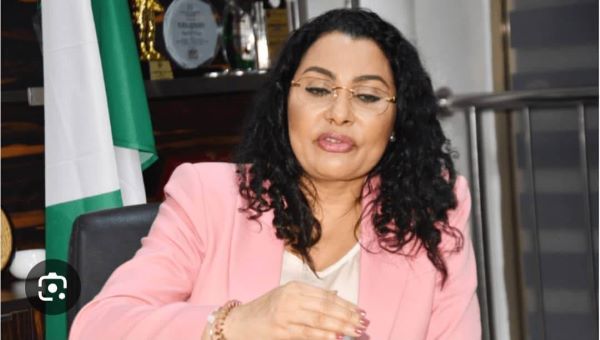
Minister of State for Finance, Doris Uzoka-Anite, has revealed that Nigeria must maintain an annual economic growth of between 10 and 12 percent over the next decade to achieve the $1 trillion economy target.
Uzoka-Anite spoke on Wednesday at the 2026 annual general meeting of the Finance Correspondents Association of Nigeria (FICAN) in Abuja.
Speaking on the theme ‘Actualising President Bola Ahmed Tinubu’s $1 Trillion Economy Agenda’, she outlined the steps taken by the administration so far, the reforms currently underway, and why the foundation being established can support the $1 trillion ambition.
“Nigeria’s GDP currently sits at approximately $375 billion. To reach $1 trillion requires sustained GDP growth of between 10 and 12 percent annually over the coming decade. That is an ambitious target, and this administration is not shy about saying so,” the minister said.
Uzoka-Anite said the current administration inherited “structurally distorted” economic fundamentals in 2023, citing fuel subsidy payments of over N5 trillion annually and a multiple exchange rate regime that rewarded rent-seeking and weakened investor confidence.
The minister said Tinubu took two major decisions early in his tenure — the removal of fuel subsidy and the unification of the exchange rate.
“Both decisions imposed short-term pain. Neither decision has been reversed. Today, those reforms are being vindicated by the data,” she said.
“In January 2026, S&P Global Ratings revised Nigeria’s outlook to positive, affirming our B-/B credit ratings and citing measurable improvements across our external, fiscal, monetary, and economic trajectory.”
On the fiscal side, the minister said the federal government has restructured the budget framework to treat investment expenditure as a distinct pillar of public finance, separate from recurrent spending.
Uzoka-Anite said the second phase of reforms is anchored on the disinflation and growth acceleration strategy (DGAS), jointly developed by the ministry of finance and the Central Bank of Nigeria (CBN).
She described the DGAS initiative as a nine-pillar implementation framework designed to deliver non-inflationary growth above 7 percent by 2027.
The minister said Nigeria currently imports about 70 percent of the raw materials used in industrial production, noting that the country is not controlling the long-run cost structure of its economy.
“The Dangote Refinery showed what is possible when we process our own resources here rather than exporting raw inputs and buying back the finished product at a premium,” Uzoka-Anite said.
“Our goal under DGAS is to replicate that model across agriculture, mining, health, and manufacturing. When we do, the resulting job creation, tax revenues, and household wealth transfers will be of a different order of magnitude.”
She said Nigeria has submitted its ECOWAS tariff offer to the African Continental Free Trade Area (AfCFTA) secretariat, establishing zero duties on 90 percent of goods traded within the continent.