



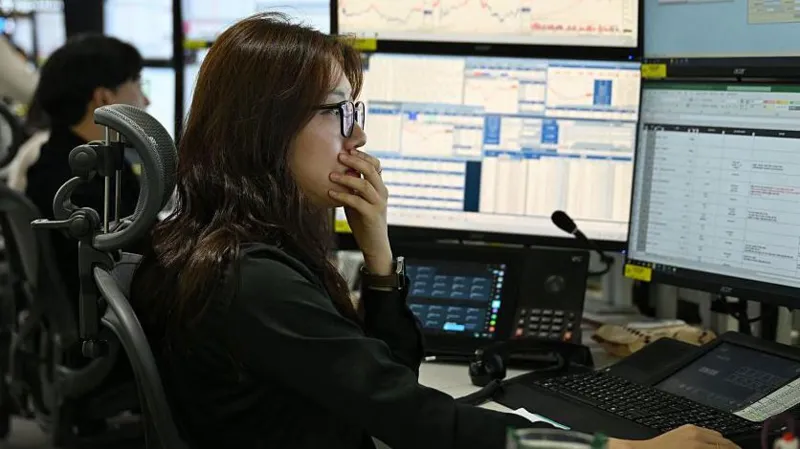
The stock market in Asia dropped for a third day in a row on Wednesday and oil prices rose higher as investors observe developments in the US-Israel war with Iran.
Share indexes in South Korea and Thailand temporarily halted trading after plunging by more than 8% and triggering so-called circuit breakers, which aim to avoid panic selling.
Brent crude oil was about 2.8% higher in Asia afternoon trade after surging over the last two days.
The conflict in the Middle East has rattled financial markets and global energy prices have soared this week after vessels near the crucial Strait of Hormuz shipping lane have come under attack.
South Korea’s benchmark Kospi index closed 12% lower, while the Nikkei 225 in Japan lost 3.6%.
In afternoon trading, Hong Kong’s Hang Seng index was 2.5% lower, while the Shanghai Composite in mainland China was down by 0.8%.
Around a fifth of the world’s oil and gas usually flows through the Strait of Hormuz narrow waterway between Iran and the United Arab Emirates (UAE), but traffic has almost entirely halted following Iran’s threats to “set fire” to ships.
Traffic through the strait has almost completely halted following Iran’s threats.
On Tuesday, President Donald Trump said the US Navy will protect ships in the region “if necessary” in a bid to stop the energy supply crunch sparked by the war.
He said Washington will provide risk insurance “at a very reasonable price” to all shipping firms in the region to “ensure the FREE FLOW of ENERGY to the WORLD”.
Stock markets have fallen sharply since the US and Israel attacked Iran over the weekend.
Many Asian stock markets have been hit particularly hard as the region imports large amounts of energy from the Middle East that has to pass through the Strait of Hormuz.
Shares have also fallen in export-reliant countries like South Korea and Japan, which are especially vulnerable to geopolitical shocks that put shipments at risk.